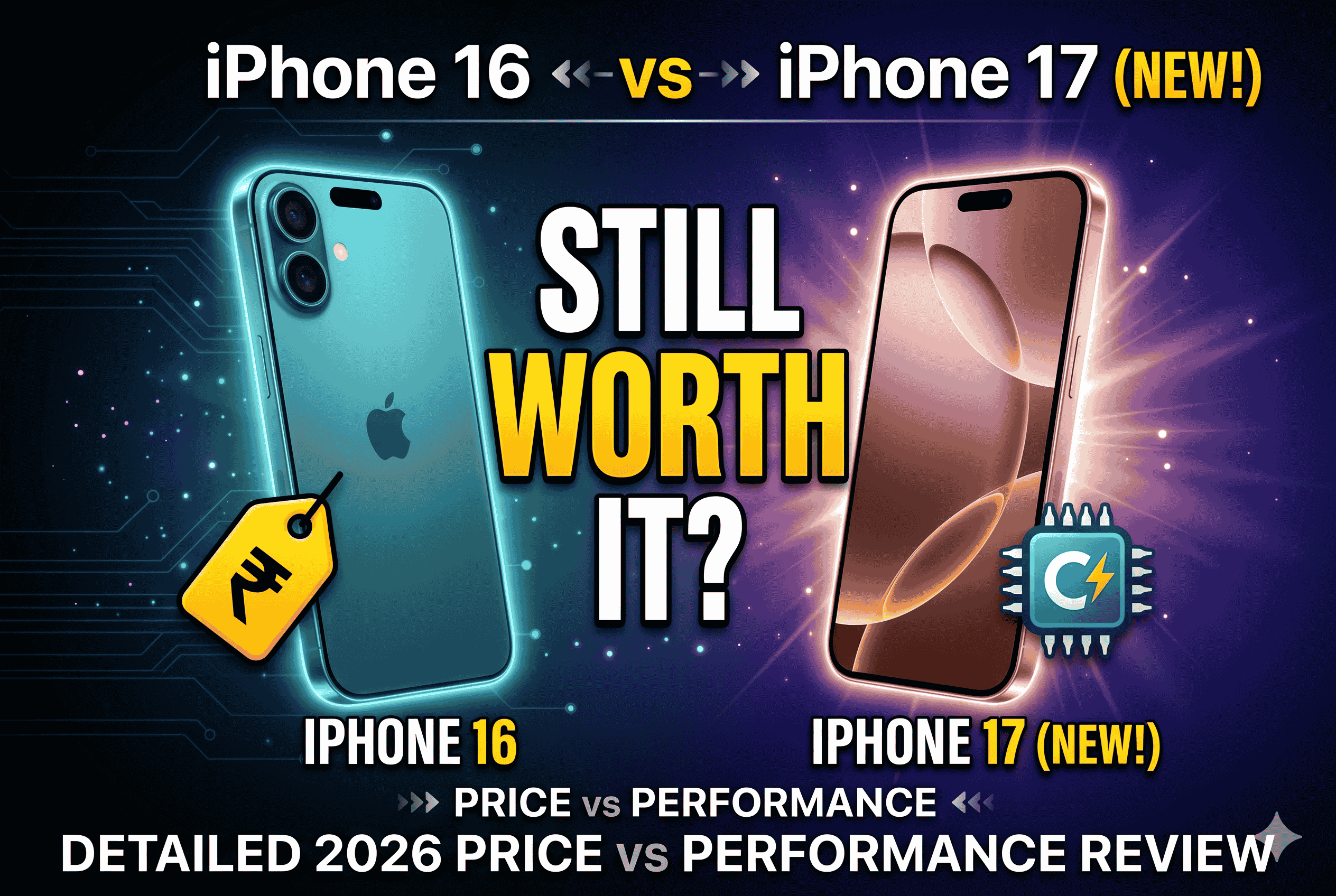
Every September, Apple does what Apple does best — makes last year’s phone feel like a museum exhibit. But here is the thing: that “museum exhibit” just got $100 cheaper, and it still runs everything you need just fine. So, before you rush to upgrade, let us talk real numbers, real specs, and real value.
What Apple Actually Changed with the iPhone 17
The iPhone 17, launched in September 2025, starts at $799 and features the A19 chip, a 6.3-inch OLED display with 120Hz ProMotion, Always-On functionality, and a dual 48-megapixel camera system. MacRumors That sounds impressive — and it is — but the question is whether those upgrades justify skipping a now-discounted iPhone 16.
The iPhone 17 also marks the first time a non-Pro iPhone gets ProMotion and Always-On display features, which were previously exclusive to the Pro lineup. Wikipedia That alone is a meaningful shift for everyday users who felt left out of the buttery-smooth scrolling experience.
The iPhone 16 Price Drop Is Real — and Worth Your Attention
Here is where things get interesting for budget-conscious buyers. After the iPhone 17 launched, Apple dropped the iPhone 16 series price by $100 off the original MSRP. Carriers like T-Mobile and Verizon went even further, offering up to $1,000 off in trade-in deals.
The iPhone 16 now starts at $699 for the 128GB model that is a legitimately good price for a phone that launched less than a year ago. If you have been eyeing an iPhone upgrade but do not want to pay flagship money, the iPhone 16 at $699 is the deal the Apple ecosystem rarely gives you.
Performance Reality Check: A18 vs A19
Let us be honest. For 90% of users — social media, streaming, calls, photos — the A18 chip in the iPhone 16 is more than enough. You are not going to notice a difference while scrolling Instagram. Both the iPhone 16 and iPhone 17 support Apple Intelligence, so users of last year’s model won’t miss out on Apple’s AI features.
That said, benchmarks do tell a clearer story for power users. Geekbench results show the A18 scoring 3,242 in single-core and 7,976 in multi-core, while the A19 scores 3,627 and 9,249 respectively — a 12% improvement in single-core and 16% in multi-core performance. It is a real improvement, not a marketing illusion. But for gaming and video editing professionals, the A19 brings faster app launches, shorter video export times, and higher frame rates in demanding games compared with the A18-powered iPhone 16.
Display: The Biggest Reason to Consider Upgrading
If there is one area where the iPhone 17 genuinely pulls ahead for everyday use, it is the display. The iPhone 17 gets a 6.3-inch ProMotion 120Hz OLED with Always-On Display — the first time these features have appeared on a standard non-Pro iPhone. The iPhone 16 has a 6.1-inch 60Hz panel with no Always-On. Iphonescompare
That 60Hz vs 120Hz difference is something you feel immediately once you switch. It is the kind of upgrade that sounds minor on paper but feels major in daily use. If you spend hours on your phone every day — and most people do — the smoother display is not a gimmick.
Battery Life and Charging: A Clear Win for iPhone 17
The battery story is exceptional — the iPhone 17 rates at 30 hours of video playback versus 22 hours on the iPhone 16, a 36% jump that puts it comfortably into two-day territory for average users. Iphonescompare That is a genuine generational leap, not a spec sheet boast.
Apple’s new 40W Dynamic Power Adapter with 60W Max charger can add a 50% charge to the iPhone 17 in just 20 minutes Macworld, compared to around 30 minutes on the iPhone 16 with a 20W adapter. For anyone who charges their phone during a lunch break, that difference matters.

Camera Upgrades: Meaningful, but Not for Everyone
The iPhone 17 raises the ultrawide camera from 12MP to 48MP, matching the main lens in resolution and enabling dramatically sharper wide-angle shots. The front camera also jumps from 12MP to 18MP, a significant improvement for selfies and FaceTime.
If you shoot a lot of content, host video calls professionally, or care deeply about wide-angle photography, the iPhone 17 camera system is meaningfully better. If you mostly take casual photos and portraits, the iPhone 16’s 48MP main camera continues to deliver excellent results.
So, Who Should Actually Buy the iPhone 16 Right Now?
If you already own an iPhone 16 and are satisfied with battery life and camera results, you’ll see meaningful but not revolutionary gains — upgrades are compelling for power users but optional for casual users. Product Review Crew
But what if you are coming from an iPhone 13, 12, or older? In that case, even the iPhone 16 at $699 represents a massive leap — better chip, better cameras, USB-C, Apple Intelligence support, and years of software updates ahead.
For budget-restricted users, the months from January through April-May each year are the best time to buy an older iPhone, as previous models significantly lose market value during this window. ESRTECH Right now, that window is open.
The Verdict: Honest Value Breakdown
The iPhone 17 is the better phone. That is simply true. But “better” does not always mean “right for you.” If you want a 120Hz display, improved battery, faster charging, and a sharper ultrawide camera — and do not mind paying $799 — the iPhone 17 earns that price. IGN’s reviewer called it “Apple’s best entry-level iPhone in years.”
If you want a capable, fully supported iPhone at a genuine discount, the iPhone 16 at $699 — especially with carrier deals — makes excellent sense. It is fast, it runs all modern apps, and it will receive iOS updates for years to come.
The iPhone 16 is not obsolete. It is just affordable now. And sometimes, that is exactly what you need.
FAQs
Is the iPhone 16 still worth buying in 2025 after the iPhone 17 launch?
Yes — for most users the iPhone 16 is still an excellent buy. After the iPhone 17 launched, Apple dropped the iPhone 16 price by $100, bringing it to $699. It runs Apple Intelligence, supports 5G, and will receive iOS software updates for years. If you are upgrading from an iPhone 13 or older, the iPhone 16 is a significant leap at a lower price than the iPhone 17.
What is the price difference between the iPhone 16 and iPhone 17?
The iPhone 17 starts at $799 with 256GB of base storage. After the iPhone 17 launch, Apple reduced the iPhone 16 price to $699 for the 128GB model. That is a $100 difference, and carrier deals from T-Mobile and Verizon can push the iPhone 16 price even lower — sometimes to near zero with qualifying trade-ins.
Is the A19 chip in the iPhone 17 much better than the A18 in the iPhone 16?
The A19 chip is faster — around 12% better in single-core and 16% in multi-core benchmarks compared to the A18. For everyday tasks like browsing, social media, and streaming, you will not notice a difference. The improvement is most visible for video editing, gaming, and AI-intensive tasks. Both chips fully support Apple Intelligence.
Does the iPhone 16 get the iPhone 17’s iOS 26 update with Liquid Glass?
Yes. The iPhone 16 is fully compatible with iOS 26, which brings Apple’s new Liquid Glass design, Live Translation, Call Screening, and expanded Apple Intelligence features. You do not need to buy the iPhone 17 to get the new software experience — the iPhone 16 gets all of these iOS updates.
What are the biggest reasons to choose the iPhone 17 over the iPhone 16?
Three upgrades stand out. First, the display — the iPhone 17 has a 6.3-inch 120Hz ProMotion OLED with Always-On, while the iPhone 16 is 6.1 inches at 60Hz with no Always-On. Second, battery life — the iPhone 17 offers 30 hours of video playback versus 22 hours on the iPhone 16. Third, cameras — the iPhone 17 upgrades the ultrawide to 48MP (from 12MP) and the front camera to 18MP. If those matter to you, the iPhone 17 justifies the $100 premium.